Published 2026-07-29
Most gutter problems are repairs. Sagging sections, leaking corners, crushed downspouts and bad pitch are all fixable, and a contractor who quotes a full replacement for any of those is either not looking closely or not being straight with you.
But some systems genuinely are done. Here's how to tell which one you have.
1. Split seams in more than one place
Aluminum that has cracked along a seam has fatigued. You can seal it, and it will hold for a season or two, then open again a few inches further along. One split is a repair. Splits in several places mean the metal itself has reached the end of its life.
2. The fascia line has sagged
This is the one most people miss. If the wood the gutter hangs from has bowed, no amount of rehanging will fix the pitch, because the mounting surface itself is no longer straight. Sight along the fascia from a corner of the house — if the line dips, you're looking at carpentry plus new gutter, not a gutter repair.
3. Widespread pinholes or rust
On steel gutters, rust starting at cut edges and spreading is terminal. On aluminum, small pinholes appearing along the bottom of the trough usually mean corrosion from years of standing debris. Both are patchable individually and neither is patchable at scale.
4. The gutter is undersized for the roof
If your gutters overflow during heavy rain and they're demonstrably clean, the system may simply be too small. Five-inch gutter on a large or steep roof in Buchanan County — where 1–2 inch rainfall events are routine in spring — will overflow no matter how well you maintain it. That's a spec problem, and the fix is larger gutter and downspouts, not another cleaning.
5. Nails and spikes backing out repeatedly
Older systems hung with spikes and ferrules work loose over time as the wood expands and contracts. Driving them back in buys you a season. If you're doing that every year across multiple sections, the system wants modern hidden hangers, which in practice means new gutter.
6. Visible separation from the fascia
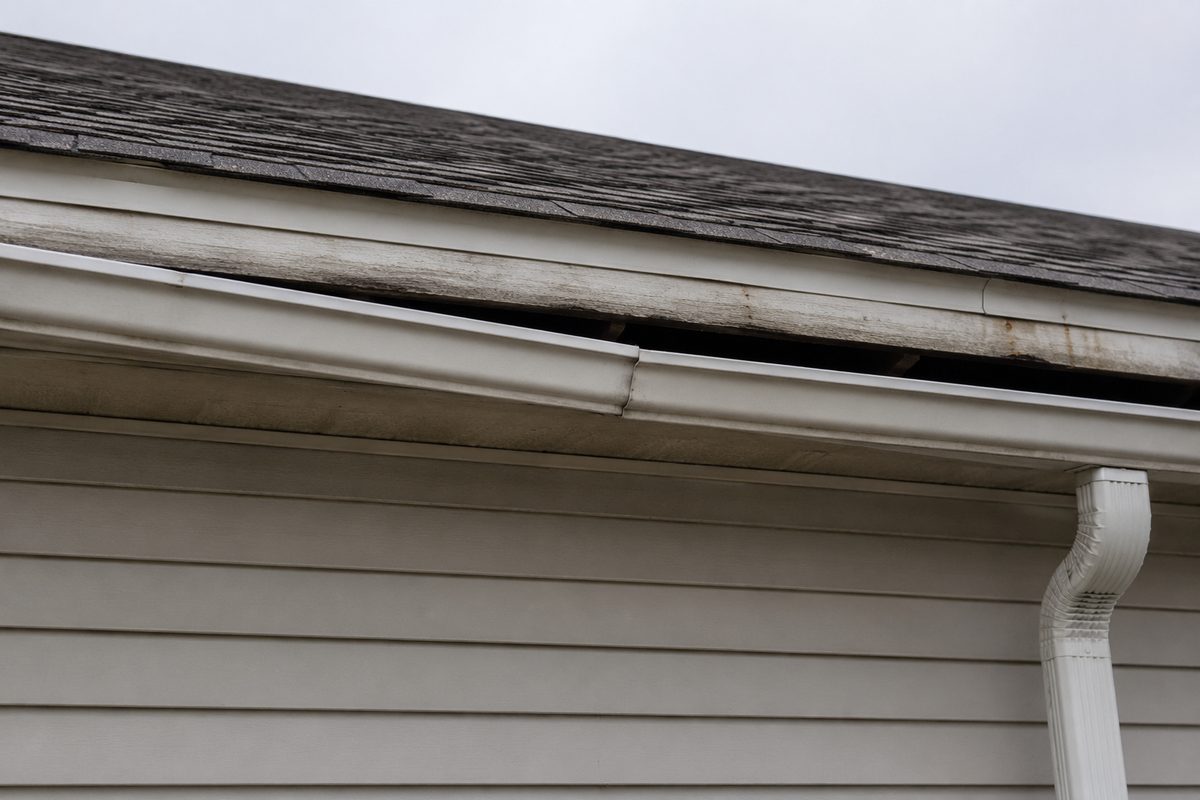
A gap between the back of the gutter and the fascia board means water is running behind the system and down the wall. That's the most damaging failure mode because it's invisible from the ground — you find it when the soffit stains or the siding softens. A single separated section is a repair. Separation along a run usually means the fascia is compromised.
7. Peeling paint or staining on the siding below the gutter line
This is a symptom, not a cause, and it tells you the system has been failing for a while. Worth investigating whatever it's pointing at.
8. You're patching something every year
Not a technical criterion, but a practical one. If you've called someone out three years running for a different leak each time, you're paying for a replacement in installments and not getting one.
The cost rule
For the ambiguous cases, there's a straightforward test: when the repair estimate approaches half the cost of replacing that run, replace it.
A $180 repair on a run that would cost $900 to replace is obviously worth doing. A $400 repair on that same run is not — you're spending nearly half the money for a fraction of the remaining life, and you'll likely spend the rest within a few years anyway.
Local numbers for reference: repairs typically run $95 to $300 depending on scope, and new seamless gutter runs roughly $5 to $8 per linear foot for 5-inch aluminum. Full local pricing is here.
What to ask the estimator
Whoever looks at your gutters should be able to answer these without hedging:
- Is the fascia sound, and did you actually check it?
- Which specific sections are failing, and which are fine?
- What would the repair cost, and what would replacing that run cost?
- If we repair it, what's your honest estimate of how long that buys?
An estimator who answers all four is worth trusting. One who won't quote a repair option at all is selling a replacement, and you should get a second opinion. Our page on gutter repair in St. Joseph covers what's genuinely fixable.
One thing that isn't a sign
Age alone. A properly installed seamless aluminum system with sound fascia behind it can run 20 to 30 years. If yours is old and still draining correctly, sitting tight against the fascia, and not leaking, the correct action is to keep cleaning it. "It's twenty years old" is not a diagnosis.